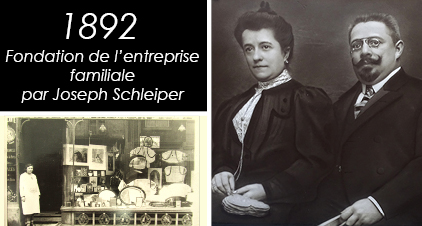
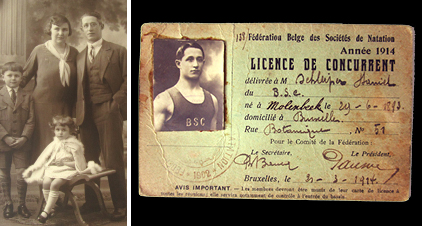
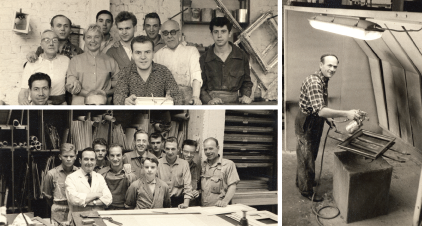
1892 - Establishment of the family business by Joseph Schleiper Whilst Victor Horta was building the Hôtel Tassel in Brussels and François Hennebique was filing the patent for reinforced concrete, Joseph Schleiper set out to establish a small family business at 51 Rue Botanique in Brussels. He was a glazier. He decided to produce mirrors and frames using traditional methods, drawing on the expertise of specialist craftsmen. His son Daniel learnt the trade and worked as a labourer in his father’s small business. In his spare time, he took part in swimming competitions.
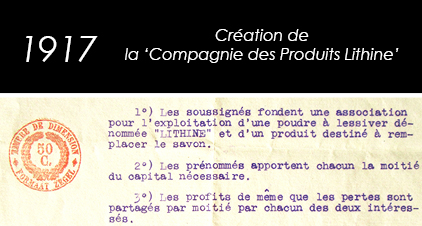
1917 - Establishment of the 'Compagnie des Produits Lithine' Daniel Schleiper, residing at 51 Rue Botanique, enters into a partnership with N. Delporte, a soap maker and manufacturer of chemical products, residing at 56 Rue Quinaux. The undersigned are establishing a partnership for the production of a washing powder called ‘lithine’ and a product intended to replace soap. The partnership is named ‘Compagnie des Produits Lithine’ and was established on 6 July 1917. The registered office is situated at 35 Rue James Watt.
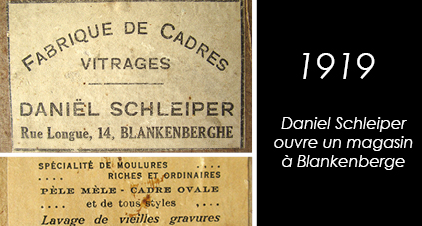
1919 - Daniel Schleiper opens a shop in Blankenberge His son, Daniel Schleiper, took up the mantle and now oversees the running of the family workshop. He set up shop in Blankenberge. The damage caused by the war there was extensive and there was a shortage of glaziers. He became a representative for Dolken & Co GmbH.
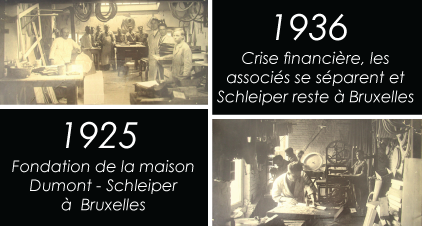
1925 - Establishing the Dumont–Schleiper firm in Brussels Back in the capital, Schleiper partners with a framer, Maurice Dumont. The Dumont-Schleiper firm was established at 46 Rue Gray. Around ten workers were employed by the company. Exports to France were substantial. The main focus of the business shifted to the manufacture of frames and framing.
1936 - Financial crisis: the partners go their separate ways and Schleiper stays in Brussels The crisis breaks out in France and the local currency is devalued by 40%. The Dumont-Schleiper partnership is on the brink of bankruptcy. The two partners go their separate ways. Dumont leaves for France, whilst Schleiper remains on Rue Gray. The situation stabilises.
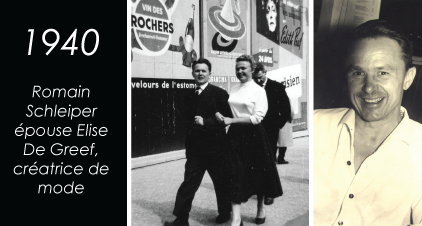
1940 - Romain Schleiper marries Elise De Greef, a fashion designer Romain, the founder’s grandson, marries Elise De Greef, a fashion designer, on 21 December 1940. They were both 20 years old! She studied at Bisschofsheim and taught at the Institut Couplet. She helped to design new frame profiles for artworks. Romain and Elise are great art lovers, particularly of Oriental art, which is Elise’s passion.
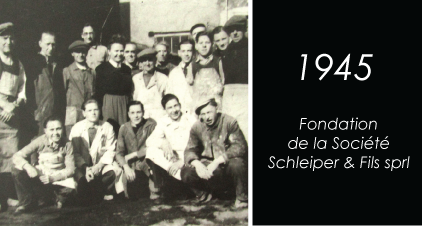
1945 - Establishing Schleiper & Fils sprl Schleiper et Fils SA is established at the end of the Second World War. Romain (Valère) takes over the management of the company. Passionate about antiques from the age of 15, he would scour the Vieux Marché in search of old books, and later paintings depicting horses... It was at this point that the great expansion of the glaziers and framers began.
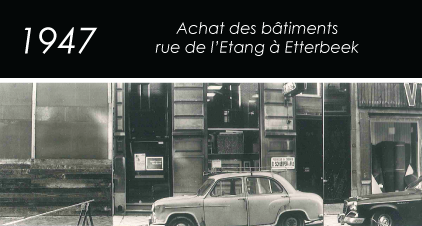
1947 - Purchase of the buildings on Rue de l'Etang in Etterbeek Schleiper constructs new buildings on Rue de l’Etang. These are in addition to those on Chaussée de Charleroi… the company is expanding. That same year, the World Health Organization removes homosexuality from the list of mental illnesses. The world is finally changing...
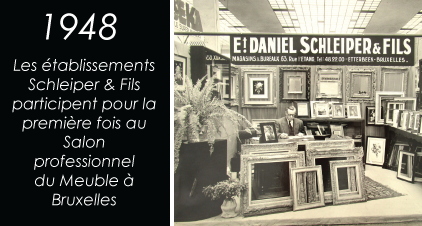
1948 - Schleiper & Fils participates in the Brussels Furniture Trade Fair for the first time First exhibition in April at the Brussels Furniture Trade Fair. Schleiper decides to make its mark and showcases its craftsmanship. 1948 was also the year in which women were granted the right to vote in parliamentary elections. Until then (since 1920), they had only been able to vote in local elections.
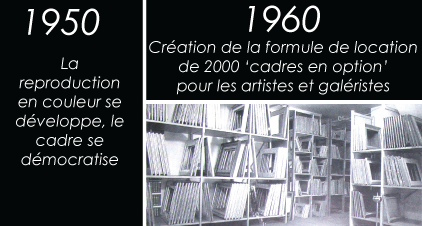
1950 - Reproductions of artworks in colour develop, the art frame democratises itself During the late 1940s, people stopped photographing scenes of war, and photography became a form of decoration. Cartier-Bresson, Doisneau, Helmut Newton, Helen Levitt… all contribute to the growing popularity of photography. At the same time, the reproduction of works of art in colour begin to develop. Schleiper creates simple, inexpensive frames designed to hold these two-dimensional works.
Early 60s - Launch of the 2000 ‘optional frames’ rental scheme for artists and gallery owners During the early 60s, Schleiper creates the ‘Frames as an Option’ scheme. A more attractive option for artists than buying a frame outright, Schleiper offers nearly 2,000 frames in standard sizes at 10 per cent of their value to enable young artists to exhibit their work in the best possible conditions. Should the artist decide to purchase the frame outright, they need only pay the remaining 90 per cent. An effective way of contributing to the promotion of the arts.
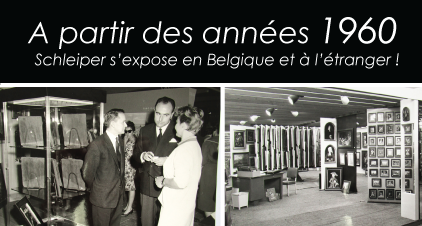
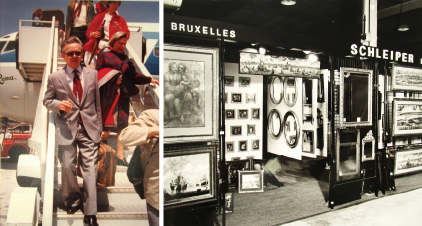
Late 60s - Schleiper exhibits in Belgium and abroad From 1966 to 2004, Schleiper continues to exhibit at various trade fairs in Brussels (Salon du Meuble), Munich, Cologne, Birmingham, Paris (Equiphotel), Frankfurt, Lyon (Meuropan) and Basel, with the aim of reaching retailers and suppliers to major hotels as far afield as North Africa.
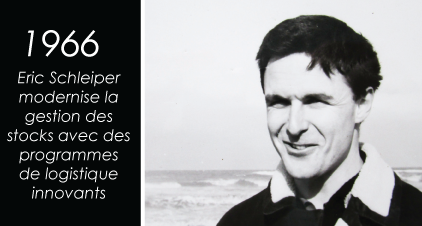
1966 - Eric Schleiper modernises stock management with innovative logistics programmes In that year, China embarks on its Cultural Revolution. Eric Schleiper, the founder’s great-grandson, is 26 years old and launches his own IT revolution. With a degree in political science and diplomacy, he invests in an inventory management programme for the management team. Real-time tracking of orders, production lead times, invoicing and stock movements – everything is under control. A true revolution for the family business, which is still steeped in the logistics expertise of previous generations.
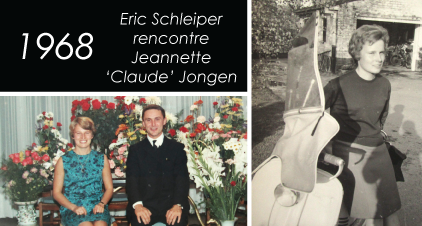
1968 - Eric Schleiper marries Jeannette “Claude” Jongen On 12 March 1968, Eric Schleiper marries Claude Jongen, the granddaughter of the famous Belgian composer and organist Joseph Jongen (1873–1953). Also a graduate in political science and diplomacy, Claude Jongen is passionate about art and works tirelessly to classify the different frame profiles.
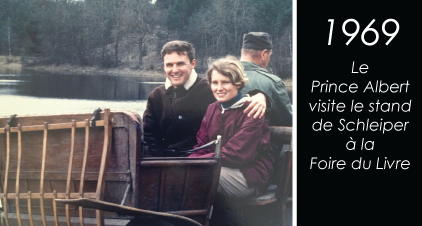
1969 - Prince Albert visits the Schleiper stand at the Book Fair Prince Albert attends the Brussels Book Fair, and visits the Schleiper stand. Did he come by car? That is by no means certain, as statistics from the Ministry of Economic Affairs show that only one in seven people in the Common Market owns a car.
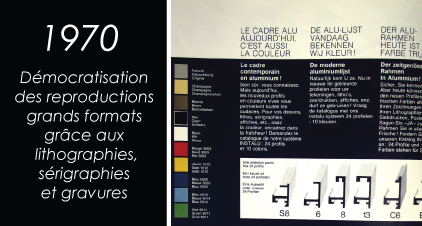
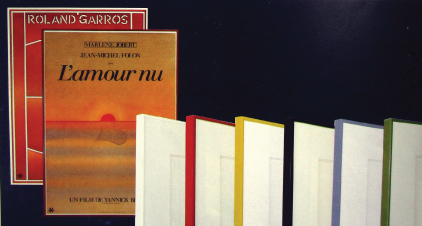
1970 - The democratisation of large-format reproductions through lithographs, screen prints and engravings The arrival of large-scale editions of lithographs, engravings and screen prints leads to the democratisation of visual art and creates a growing demand for frames. Schleiper markets the ‘Instalu’ aluminium frame, designed for self-assembly. “Instalu” and “Instalu Clips” – which are detachable, interchangeable and universal (suitable for framing everything from a thin engraving to a painting on a stretcher) – are launched directly onto the market without intermediaries and at unbeatable prices. Without realising it, Schleiper was already setting the trend for do-it-yourself: DIY!
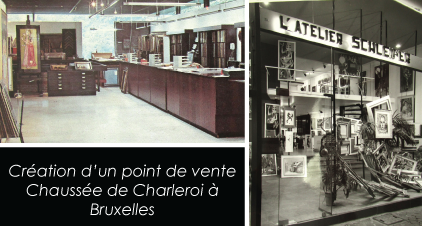
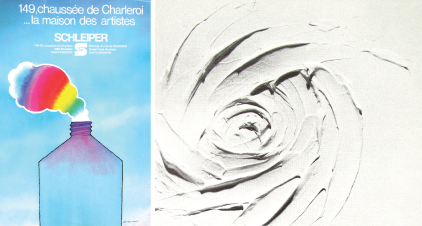
Opening a store on Chaussée de Charleroi in Brussels A new Schleiper store opens on Chaussée de Charleroi. The standard framing range continues to grow, whilst Schleiper is launching a ‘made-to-measure’ service.
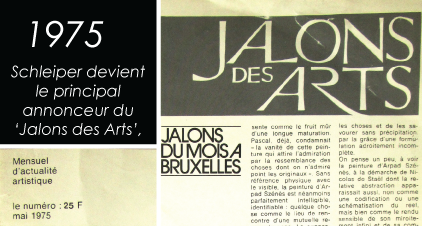
1975 - Schleiper is the main sponsor of ‘Jalons des Arts’ Schleiper takes an interest in modern media. He is the main advertiser in the magazine “Le Jalon des Arts”, the Belgian monthly covering the arts. This publication, with a print run of 20,000 copies, is aimed at all art professionals and enthusiasts. Although the publication does not officially belong to the Schleiper company, the latter holds a majority stake in the publishing house. It will serve as a showcase for the Galerie Claude Jongen. On the world stage, the UN proclaims the International Women’s Year and Microsoft is founded.
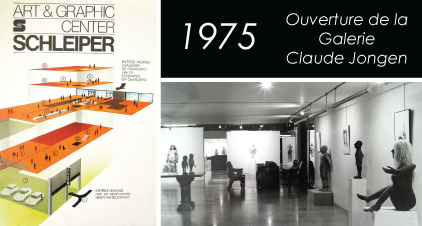
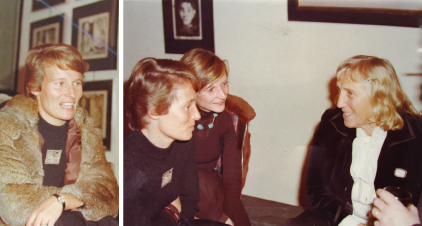
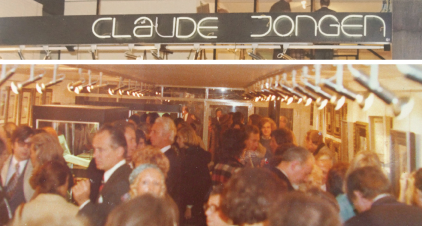
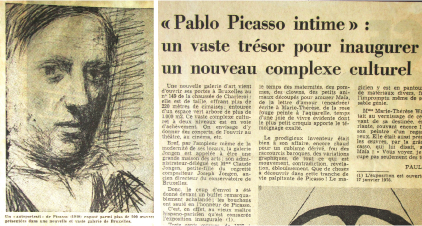
1975 - Opening of the Claude Jongen Gallery The Claude Jongen Gallery opens on Chaussée de Charleroi, featuring a unique exhibition: ‘Picasso as told by Marie-Thérèse Walter’, Picasso’s model and muse for around ten years and mother of his daughter, Maia. The works on display belong to Marie-Thérèse Walter. The opening of the Claude Jongen Gallery is unanimously hailed by the press as a bold initiative: 220 metres of picture rails, 1,000 square metres of outdoor space with trees, and flexible spaces across two levels that will host both intimate exhibitions and large-scale events. The link between art supplies and artists’ works has finally been established.
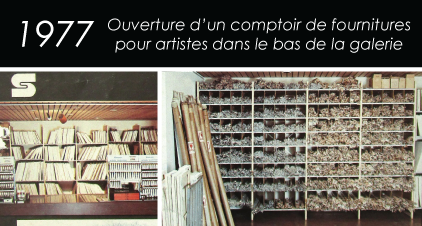
1977 - Opening the art supplies counter at the back of the gallery In response to constant requests from artists exhibiting their work at the Galerie Claude Jongen, the Schleiper family decide to open an art supplies shop. The shop is set up on the ground floor of the gallery, on Chaussée de Charleroi. Schleiper embarks on a new venture, a world of colour brought to life by thousands of tubes of paint. The paint manufacturers Daler and Rowney are the first to place their trust in Schleiper. And they were right.
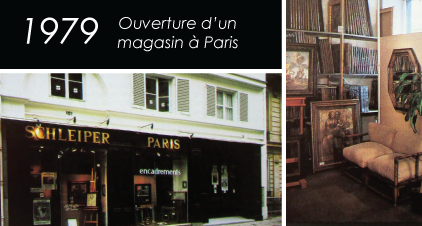
1979 - Opening a new Schleiper store in Paris ‘Schleiper opens a store on Rue Penthièvre in Paris, just a stone’s throw from the Faubourg Saint-Honoré and the Champs-Élysées.’
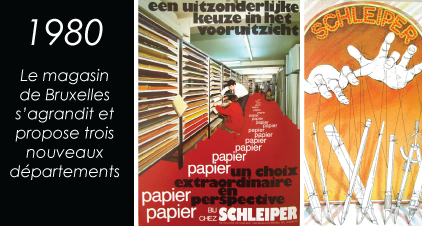
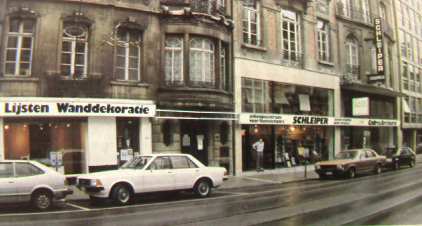
1980 - The Brussels store expands and introduces three new departments The Brussels store expands (with a sales area and car park covering 3,000 m²) and customers wander through three new departments: Fine Arts, Graphic Arts and Paper in all its forms. Meanwhile, journalists write impassioned articles about the end of apartheid in Zimbabwe and the founding of Solidarność in Poland. The world is changing. So is Scheiper.
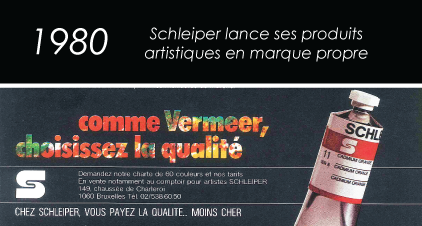
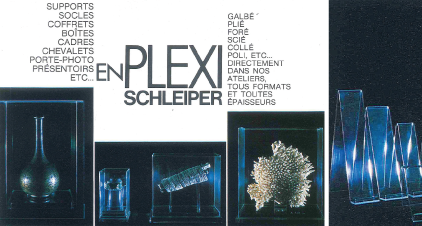
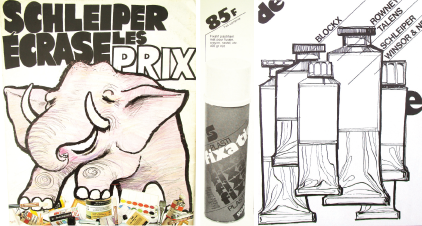
1980 - Schleiper launches its private label art products In 1970, Carrefour stores launched their own-brand range, ‘Marque De Distributeur’, offering customers ‘unbranded products’. Just ten years later, Schleiper decides to follow in their footsteps and launches its own-brand products. With own-brand products having proven their worth, Schleiper could venture into the market with confidence. The company also launches ‘shock’ advertising campaigns focusing on price! Plexiglas makes its debut in the Schleiper range. Achille, a skilled worker, is sent to Germany for training. A real revolution!
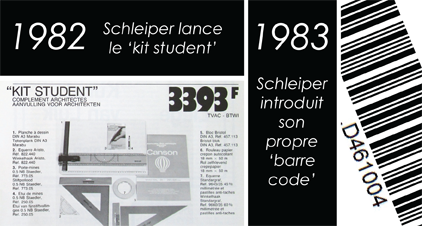
1982 - Schleiper launches the 'student kit' Schleiper comes up with the idea of offering student ‘kits’. “It is possible to cut your education budget by 30%!
1983 - Schleiper introduces its own 'barcode' Globalisation is the order of the day. Yet almost all of Schleiper’s suppliers are Belgian. Suppliers of cardboard and paper, fabric manufacturers, glassmakers (Verstraeten), timber merchants (Trap), manufacturers of varnished mouldings (Bazin), aluminium profile manufacturers, fabric suppliers (Lagae)... Being Belgian and keeping the Belgian economy going is one of Schleiper’s guiding principles. This is also the year in which Schleiper introduces its own ‘barcode’.
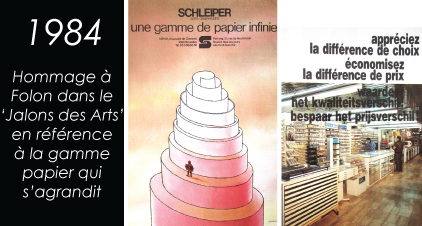
1984 - A tribute to Folon in ‘Jalons des Arts’, in reference to the expanding range of paper products Folon, a Belgian watercolourist, painter and sculptor, was born in 1934 and died in 2005. As the artists’ official supplier, Schleiper paid tribute to him in its own way by publishing this advertisement in the magazine “Le Jalon des Arts”, the Belgian monthly covering the arts. The advert, entitled ‘An infinite range of paper’ – a reference to the range offered by the Schleiper store – appears on the back cover of the magazine.
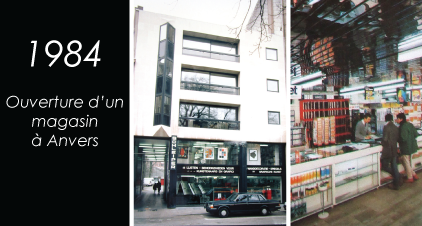
1984 - Opening a new Schleiper store in Antwerp During the year, Schleiper opens a second store in Antwerp (2,000 m²), and Apple launches the Macintosh personal computer, priced at $2,495, which quickly captured 10 per cent of the market.
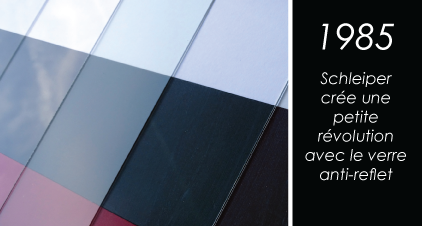
1985 - Schleiper brings about a minor revolution with its anti-glare glass The new 100% transparent anti-reflective glass is a real revolution in the world of framing. It combines the advantages of traditional glass and anti-reflective glass whilst retaining the glass’s full transparency.
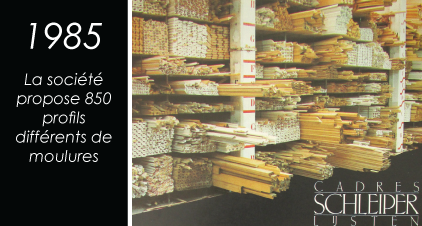
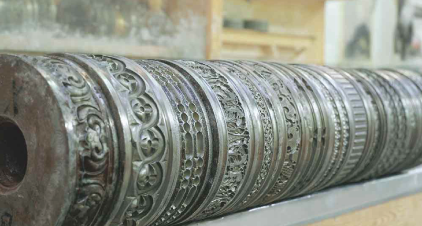
1985 - Schleiper proposes 850 different moulding profiles Schleiper offers no fewer than 850 different moulding profiles to surround your works of art. Some are created using the original moulds belonging to great-grandfather Joseph, whilst others are designed by Elise Schleiper-De Greef and her daughter-in-law, Claude Jongen. Visiting trade fairs enables them to stay ahead of trends and set them. That is exactly what they do. The mouldings are first sketched on paper; then a sample is produced using a router and submitted to retailers, who confirm the design’s originality. This creates a synergy within the company. Elise also expands the workshop’s collection of moulding dies by purchasing equipment from companies that have gone into liquidation (mainly in France).
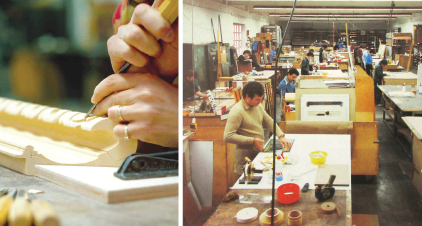
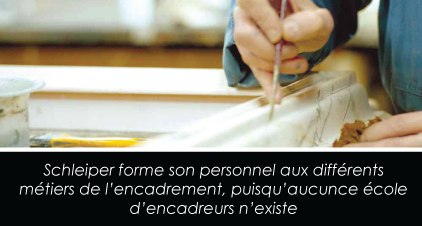
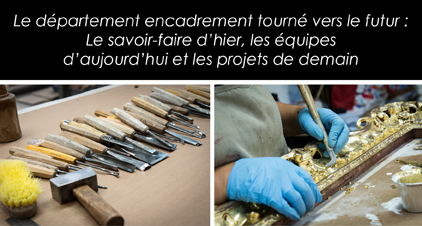
Schleiper trains its staff in the various aspects of art framing Since in 1985 there are no longer any schools for frame makers, and the instruments and tools have become impossible to find, Schleiper always trains his staff himself and, without meaning to, has created a veritable school of woodcarvers, framers, leaf gilders, and specialists in faux marble, comb-work, faux tortoiseshell and faux ivory.
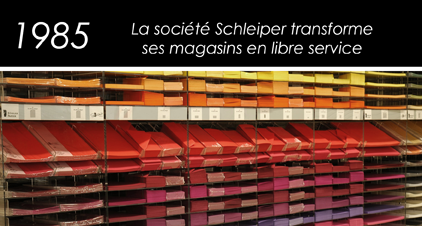
1985 - Schleiper converts to self-service In 1957, Delhaize decided to launch its first self-service shop. It was the first of its kind in Europe. Thirty years later, in 1985, Schleiper follows suit and converts its stores to self-service. Counters were replaced by accessible shelving. Customer service, however, remained the company’s priority, and the number of store assistants did not decrease as a result.
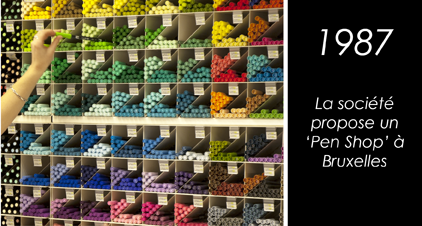
1987 - The family company runs a “Pen Store” in Brussels Schleiper has a ‘Pen Store’ inside its Brussels store.
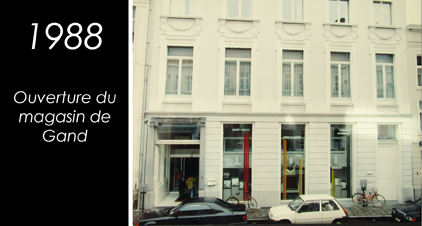
1988 - Opening a new Schleiper store in Ghent Schleiper opens a new store in Ghent (2,000 m²), situated along the River Lys in the university town’s shopping district. The building was rebuilt on the foundations of a former mansion that had belonged to the d’Udekem d’Acoz family, specifically to the uncle of Mathilde, Queen of the Belgians.
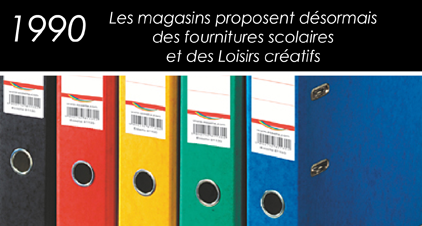
1990 - Schleiper stores sell school supplies and arts and crafts materials Late 1980s/early 1990s: Schleiper further diversifies its product range and offers a range of stationery (school supplies and office supplies) and arts and crafts in all its stores.
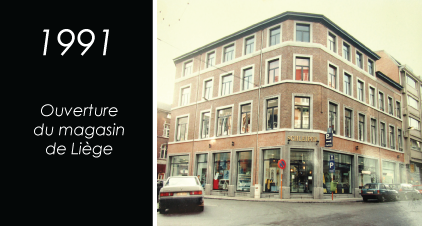
1991 - Opening a new Schleiper store in Liège The birth of the World Wide Web (www), the Internet’s web, which opened up this network to the general public. In line with this, Schleiper continued to expand by opening a third store, this time in Liège (1,200 m²). The company launched the ‘Privilege Card’.
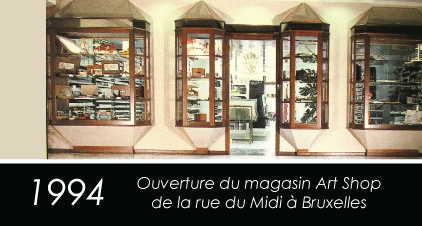
1994 - Opening the Art Shop on Rue du Midi in Brussels Paul Delvaux passed away in July 1994. A Belgian surrealist painter, he drew inspiration from everything the city had to offer, particularly the Foire du Midi, and would certainly have approved of Schleiper’s decision to set up shop in the heart of the city. A new shop opens on Rue du Midi: the Art Shop (150 m²), next to the Bedford Hotel. After 19 years in business, the shop on Rue du Midi – Schleiper’s only rented premises – is to be relocated to 63 Rue de l’Etang in Etterbeek. This is because Mr Quatacker of the Bedford Hotel wishes to reclaim the premises currently occupied by the shop for his hotel.
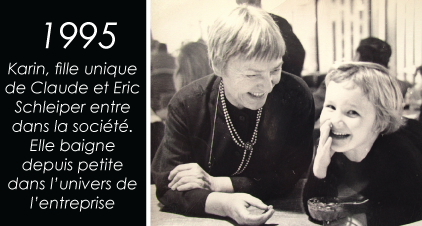
1995 - Karin, the only daughter of Claude and Eric Schleiper, enters the company. Karin, the only daughter of Eric Schleiper and Claude Jongen, born in 1971, enters the company in 1995. A graduate in Business & Administration from VUB-Vesalius College, and with a postgraduate degree in management to her name, she — having been immersed in the world of art throughout her childhood — devotes all her energy to the company. She marries a young Swede, Jon Hanson, on 29 September 1997. He, too, is passionate about economics and a graduate of the Stockholm School of Economics.
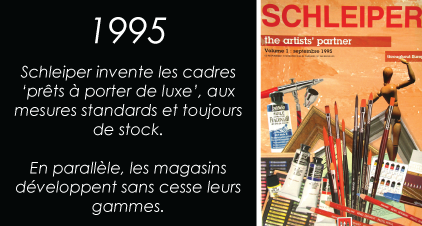
1995 - Schleiper invents ‘luxury ready-to-hang’ frames, made to standard sizes and always in stock In the mid-1990s, quick framing become a necessity. Schleiper creates an additional service: ‘luxury ready-to-hang’ frames. Made to standard sizes, they are always in stock and feature the perfect ‘bespoke’ finish.
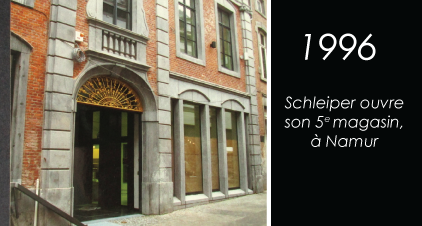
1996 - Schleiper opens a new store in Namur Dolly, the famous sheep cloned that year, gives Eric Schleiper some ideas as he opens a Schleiper store in Namur (800 m²). Far from being exact replicas of the previous ones, each store has its own personality, its own character and its own staff, who are deeply attached to their store.
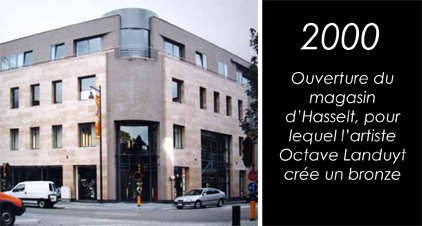
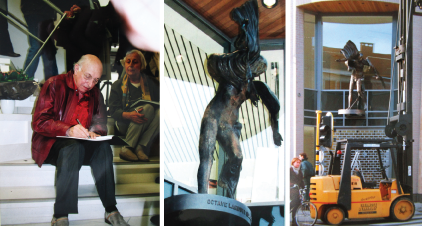
2000 - Schleiper opens a new store in Hasselt, for which the artist Octave Landuyt created a bronze sculpture The Y2K computer transition went off without a hitch, despite the fears of large companies. Schleiper takes the opportunity to open a new store in Hasselt. A bronze sculpture by Octave Landuyt, a Belgian artist and friend of the family, stands proudly above the entrance to the store, now known as the ‘Octave Landuyt Building’. Half angel, half man, the statue stands 2 metres tall. The opening of the Hasselt store coincides with an exhibition of the artist’s works in the store. March 2000 sees the bursting of the dot-com bubble. Schleiper chooses this moment to launch its website and make its debut online.
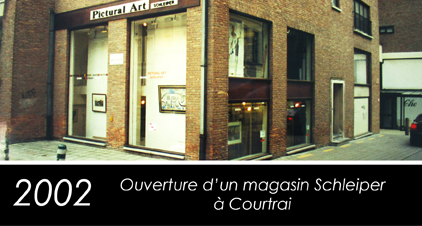
2002 - Opening a new Schleiper store in Kortrijk Located just 30 km from Lille, the city of Kortrijk is the ideal location for the opening of a new Schleiper store (taking over the Pictural Art store). Situated 50 metres from ‘K in Kortrijk’, a three-storey shopping centre, the store is at the heart of the pedestrianised shopping area. It was in Kortrijk that Belgium’s first pedestrianised street, the Courte Rue des Pierres, was created. At the beginning of the year, Cyril was born. The son of Karin and Jon, he represents the sixth generation of the Schleiper/Hanson family.
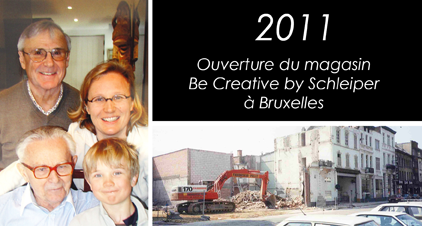
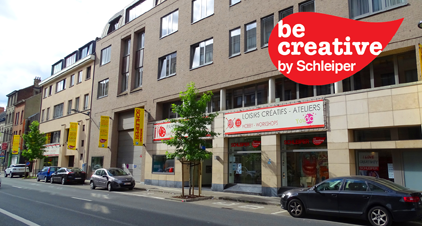
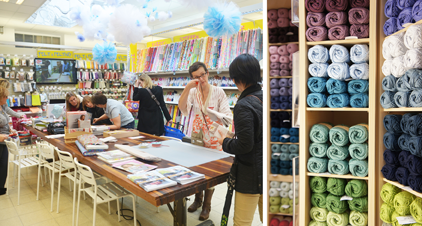
2011 - Opening the Be Creative by Schleiper store in Brussels Be Creative by Schleiper opens in Brussels. 1,000 m² dedicated to creative hobbies and DIY. This store is completely different in concept from the other Schleiper stores. A little nod to health: since July 2011, smoking has been banned in all enclosed public places throughout the kingdom. Be Creative by Schleiper can breathe easy!
Photo on the right: Four generations together: Romain (seated on the left), next to him, Cyril, his great-grandson. Standing on the left is Eric, Romain’s son, and next to him is Karin, his daughter.
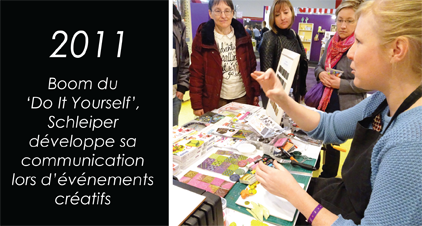
2011 - With the rise of the ‘Do It Yourself’ trend, Schleiper steps up its communications at creative events The ‘do-it-yourself’ trend, which has seen a sharp rise in online DIY resources and the growth of communication via the internet, blogs, YouTube and so on… encourages Schleiper to step up its customer engagement. With a presence at craft fairs, trade shows and other DIY events, the company also organises ‘Journées Folles’ twice a year at the Be Creative By Schleiper store. A ‘creative’ event eagerly anticipated by all customers!
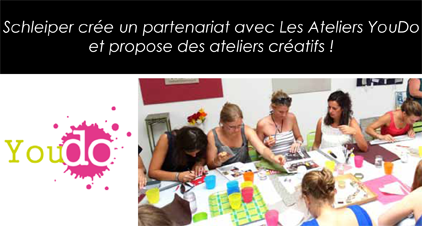
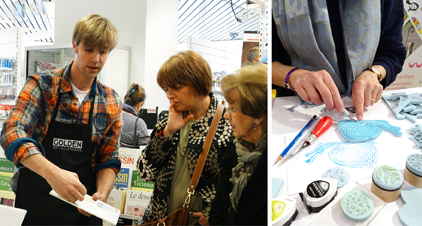
Schleiper partners with the “YouDo” workshops and offers creative workshops Displaying carefully selected products in-store is one of the company’s priorities. Offering demonstrations to show how they work has now become standard practice during the ‘Journées Folles’. The next step was to organise workshops to bridge the gap between purchasing a product and actually using it. It was in 2011 that Schleiper and YouDo decided to become partners. Based on the first floor of the Be Creative By Schleiper store, YouDo brings together no fewer than thirty instructors, each with one or more areas of expertise. The workshops are aimed at beginners, adults, children and teenagers, and cover all areas of creative leisure activities.
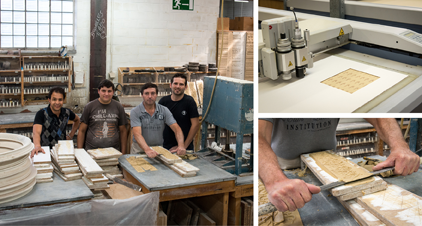
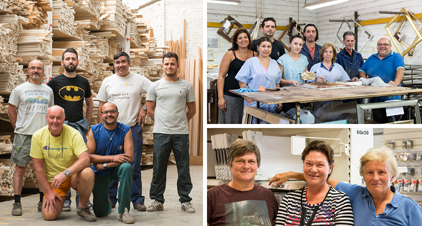
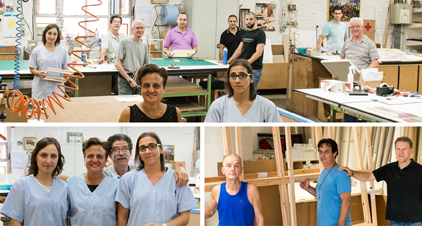
The art framing department looks to the future: Yesterday’s expertise, today’s teams and tomorrow’s projects The company has, of course, evolved since 1892, and so have its staff. The teams have changed over the years, but they remain as skilled and motivated as ever.
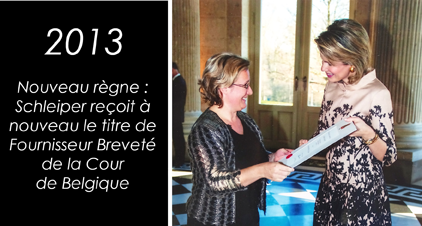
2013 - A new era: Schleiper is once again awarded the title of Certified Supplier to the Belgian Royal Court Schleiper is a supplier to the Royal Court. This patent allows the company, which is honoured by this distinction, to acknowledge this recognition. It is a privilege, but it also entails obligations: regarding quality, of course, and professional ethics. Finally, perhaps the most important point is that ‘holders of the title ensure that the quality of their service does not stop at the palace gates, but extends to all their customers. Who said the customer is king?’ (sic). The certification must be renewed at the start of each new reign.
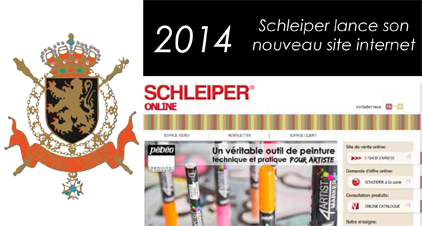
2014 - Schleiper launches its new internet website Eric Schleiper, aged 72, continues to insist: “I don’t work, I have fun!” Constantly seeking to improve his various retail outlets and the products in his range, and passionate about what the internet has to offer, Eric Schleiper is perfectly in tune with Jean Philippe Chavatte, head of the renowned French agency Carré Noir (a strategic design agency within the Publicis Group) when he states: “Useful technology is technology that serves the customer.” Schleiper launches its new website!
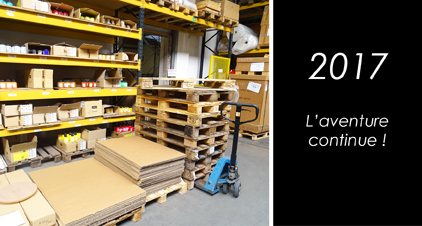
2017 - The adventure continues! New projects: The Kortrijk store grows through the purchase of two adjoining premises next to the Schleiper store in the city centre shopping arcade. A new warehouse dedicated exclusively to online orders is acquired and fitted out in line with efficient logistics. The aim? An ever more efficient customer service!
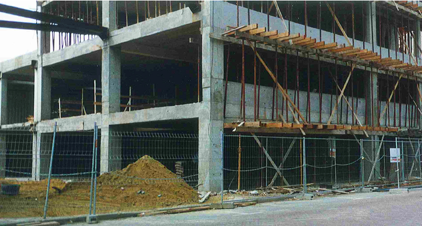
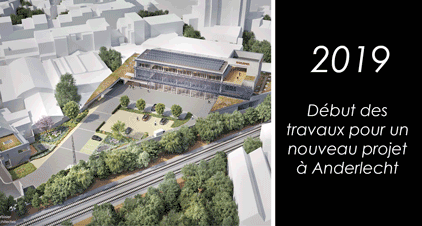
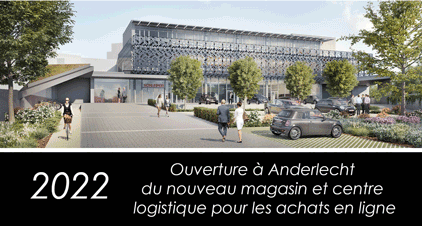
2019 - Work begins on a new project in Anderlecht Schleiper acquires a plot of land in Anderlecht and embarks on a major development project to create, within two years, a more functional distribution centre and centralise its administrative offices. This 4,000 m² logistics and commercial hub meets the latest green energy standards.
2022 - Opening of a new store and logistics centre in Anderlecht for online shopping With over 60,000 items and immediate order processing, the new facility will cater for the general public as well as trade customers and retailers. This logistics centre will also handle the distribution of online purchases. More information here




 home
home